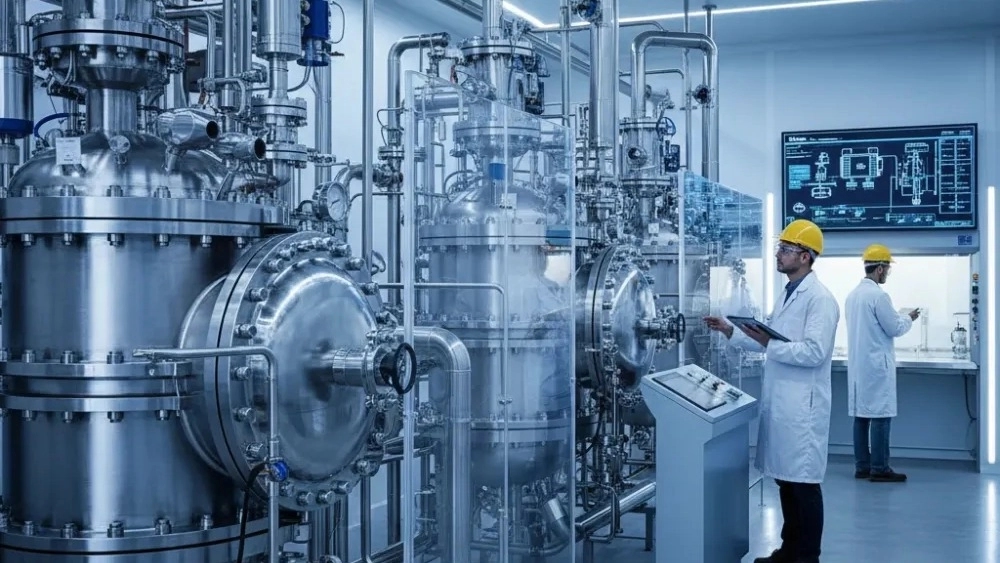
What is a high pressure reactor and why is it important?
Difference between laboratory reactor and industrial samples in research
- Extreme safety: Working with flammable gases such as hydrogen or ethylene at high pressure is very dangerous. Industrial reactors are made with special alloys (such as stainless steel 316, Hastelloy or Inconel) to be completely resistant to explosion and corrosion.
- Precise control of temperature and pressure: In nano research or pharmaceutical synthesis, even a degree of temperature difference can spoil the result. Advanced control systems in industrial high-pressure reactors allow precise adjustment of these parameters.
- Scale-up: The results obtained in a standard high-pressure reactor are much easier to translate to the scale of mass production, because the hydrodynamic and heat transfer conditions are very similar to large industrial reactors.
Key applications of high pressure reactor in different industries
The scope of application of this equipment is very wide. Today, it is rare to find an advanced laboratory that can carry out heavy projects without using some kind of high pressure reactor or laboratory autoclave. In the following, we will discuss the most important areas of application.
1. Oil, gas and petrochemical industries
The beating heart of the petrochemical industry is catalytic reactions under pressure. Researchers in this field are heavily dependent on industrial high pressure reactors to develop new catalysts for gas to liquid (GTL) conversion, hydrocracking and desulfurization.
In this research, the high pressure reactor should be able to simulate the harsh operating conditions of oil wells or pressurized distillation towers. Investigating the corrosion of oil transmission pipes in the deep sea also requires material testing in high pressure autoclaves with corrosive environment. To meet these needs, leading companies usually go to high-quality equipment from suppliers such as Pishtazan Arin Company to ensure the accuracy of laboratory data.
2. Synthesis of advanced materials and nanotechnology
One of the most attractive applications of industrial high pressure reactors is the method of hydrothermal and soluthermal synthesis. In this method, materials are dissolved in a solvent (usually water) at high pressure and temperature and then crystallized. This technique is vital for making high-purity nanoparticles, zeolites, and piezoelectric crystals.
The high pressure in the hydrothermal reactor makes water acquire strange properties; Its viscosity is reduced and its solubility power for insoluble substances is increased. Using this feature, nano researchers produce nanostructures that are impossible at atmospheric pressure. The quality of making the reactor body is very important here so that metal impurities do not enter the final product.
3. Pharmaceutical and biotechnology industries
In the development of new drugs, it is sometimes necessary to perform hydrogenation reactions (adding hydrogen). These reactions are inherently slow and require a catalyst and high hydrogen pressure. The use of high pressure reactor in pharmaceutical laboratories increases the speed of discovering new drugs.
4. Clean energy research and batteries
The development of new generation batteries and fuel cells requires the testing of electrode materials in harsh conditions. The high pressure reactor is a key tool for studying hydrogen storage in porous materials. By injecting hydrogen gas at very high pressure into the reactor containing the adsorbent, the researchers measure its storage capacity. This research is vital for the future of hydrogen cars.
Technical challenges in selecting and using high pressure reactors
Purchasing and operating a high pressure reactor is a complex process. Researchers and project managers should pay attention to several technical points. Failure to pay attention to these matters not only leads to waste of capital, but also irreparable life risks.
Choosing the right material (Metallurgy)
The most important factor is the material of the reactor body. If your reaction involves strong acids (such as hydrochloric acid) at high temperatures, even 316 stainless steel will corrode. In such a situation, a high pressure reactor with an internal coating of Teflon (PTFE) or made of expensive alloys such as tantalum or Hastelloy should be used. Consultation with the experts of Pishtazan Arin Company can be very helpful in choosing the right alloy.
Stirring and sealing systems
At high pressures, turning the stirrer inside the reactor without leaking gas is an engineering challenge. The use of magnetic coupling systems is a standard solution in modern industrial high pressure reactors. In this system, no mechanical shaft passes through the body and the power of the motor is transmitted to the stirring blades through a magnetic field, so leakage is impossible. Old reactors that used mechanical packings always faced the problem of leakage at high pressures.
Safety and control systems
Each high pressure reactor must be equipped with a Rupture Disc or safety valve to discharge the gas in case of a sudden increase in pressure and prevent an explosion. In addition, intelligent PID controllers are essential for temperature stabilization with an accuracy of 0.1°C in sensitive projects. A good industrial autoclave should have audio and visual warning systems for temperature and pressure.
The role of modular design in research flexibility
Research projects are dynamic in nature. Today you may need a 100 ml high pressure reactor and tomorrow you need a 1 liter reactor. Modern systems have a modular design; It means that the reactor vessel can be replaced while the control system, motor and base remain fixed.
This feature saves significant currency. Leading suppliers such as Pishtazan Aryan often offer this type of flexible system to universities and research centers so that they can perform a variety of experiments in different volumes with a single cost for the main unit.
Maintenance: the key to reactor longevity
A high pressure reactor is a valuable asset for any laboratory. Maintaining it correctly not only ensures safety, but also increases the life of the device by decades.
- Periodic inspection of O-rings: O-rings and gaskets are the most vulnerable parts against pressure and heat and should be replaced regularly.
- Hydrostatic test: The reactor body should be subjected to hydrostatic pressure test every few years to ensure the absence of microscopic cracks.
- Basic cleaning: Residual chemicals in the grooves of the door or body. It can cause pitting corrosion, which is very dangerous for industrial high pressure reactors.
The future of high pressure reactors: intelligence and automation
The new generation of industrial high pressure reactors are moving towards smartness. The possibility of controlling the reactor remotely with computer software, recording real-time data (Data Logging) and drawing graphs of pressure and temperature changes live has become a standard in modern research.
Imagine that the researcher can monitor the polymerization process in a high pressure reactor in the laboratory from his home and change the temperature if needed. This level of automation reduces human error and ensures repeatability of experiments. The equipment supplied by Pishtazan Arin Company often has the ability to connect to a computer and advanced monitoring software that meet the needs of researchers of the new generation.
The right choice: investing in quality
In the laboratory equipment market, the variety of price and quality is very high. Buying a cheap high pressure reactor without a valid technical certificate is a big risk. Exploding a reactor at a pressure of 100 bar can destroy the entire laboratory building.
When buying, you should pay special attention to the following points:
- Manufacturing standards: Is the device designed and manufactured according to European ASME or PED standards?
- Technical support: Does the seller have sufficient technical knowledge for installation, training and repairs?
- Test report: Are material test and pressure test reports provided with the device?
Pishtazan Arin Company: Your reliable partner in providing advanced equipment
In conclusion, it should be said that success in high-pressure research projects is a combination of the knowledge of scientists and the quality of equipment. If you are looking to equip your laboratory with high pressure reactor, industrial autoclave or special reactor systems, choosing a reliable business partner is half the way to success.
Pishtazan Arin Company is a well-known name among researchers and industrialists of the country with years of experience in the field of supplying laboratory, research and industrial equipment. With a detailed understanding of the technical needs of advanced projects, this company offers a wide range of industrial high pressure reactors with the highest global safety and quality standards.
Why Pishtazan Arin Company is the first choice of professionals?
- Expert advice: The engineering team of this company will analyze your process needs before purchasing and suggest the most suitable alloy and design.
- Product diversity: From small desktop reactors for nano synthesis to large industrial pilot systems.
- Real after-sales service: Provision of spare parts, o-rings and specialized repairs in the fastest time. possible.
- Quality assurance: All devices are provided with a valid warranty and pressure test certificates.
To improve the quality level of your research and to ensure the safety and accuracy of the tests, we recommend that you definitely benefit from the advice of Pishtazan Arin Company. Using a reliable and efficient high pressure reactor provided by this company can be a powerful accelerator to achieve your scientific and industrial goals. Don't let equipment limitations limit the flight of your research ideas; Move the boundaries of knowledge with professional equipment.